


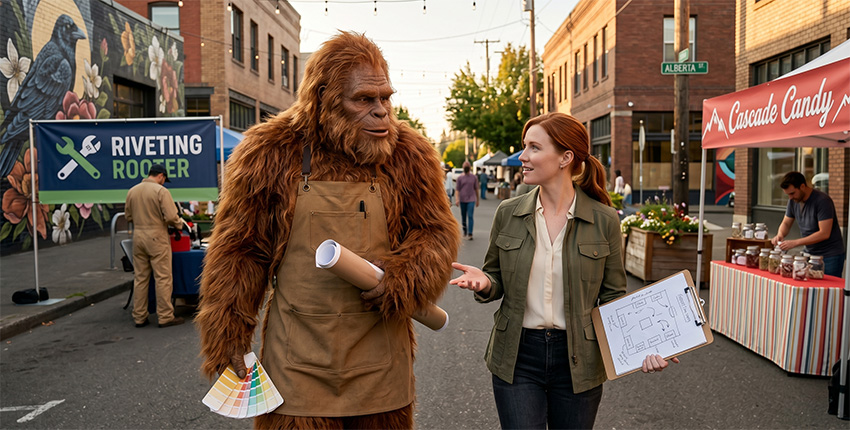
It’s 7am on a Saturday in Portland, and the event opens at 9.
The tent is going up on the Alberta Arts District block. Volunteers are arranging tables. Someone is untaping the box of banners that arrived Thursday afternoon, and when the first one gets unrolled on the pavement, there’s a pause. A long one. The green in the banner is not the green in the logo. Not catastrophically different; just enough different that anyone who’s spent the last six months looking at that brand would notice immediately.
Across the tent, half the promotional items are still in their shipping packaging. The other half are out, but the quantity is wrong. Not wrong enough to cancel the order, just wrong enough that someone is now doing the math on whether they’ll run out before noon.
The event coordinator, the one who’s been managing this campaign since January, who wrote the brief, sourced the venue, coordinated the volunteers, and handled the sponsorships, is standing there holding an almost right banner. And she has two hours.
I’ve watched this moment happen from the supply side for a long time. Different events, different streets, different coordinators; the same two hours. And I want to be honest about something, because I think it matters:
The event didn’t fail because event marketing doesn’t work. It failed because the materials were treated as an afterthought. And that’s a problem that gets decided weeks before anyone unrolls a banner.
The events that fall apart don’t fail because of strategy. They fail in the two hours before doors open, because of decisions made six weeks earlier.
The Real Reason Events Let People Down
There’s a version of the “events are dying” narrative that’s been circulating in marketing conversations for years. I don’t buy it. Portland’s event culture, the Saturday Market, the Mississippi Ave block parties, the Hillsdale Farmers Market, the Pearl District gallery openings, and the nonprofit galas in the East Side industrial buildings, is alive. People show up. They want to be in a room, or on a street, or in a field with other people.
What doesn’t work is the assumption that materials can be sorted out last. That the print order can wait until three weeks out because the strategy and venue and programming are the “real” work, and the banners and flyers and branded items are just… logistics.
They’re not logistics. They’re infrastructure.
The banner that orients someone the moment they walk through the gate. The program that gives the evening its sequence and meaning. The item someone takes home, puts on their desk, and looks at for the next two years. These pieces either support what you built or they quietly undermine it. And the difference between a piece that supports and a piece that undermines is almost always decided in a brief conversation that happened (or didn’t happen), long before the press ran.
That’s the honest diagnosis. Not that events don’t work. That the materials behind them are chronically underprioritized, underbriefed, and ordered from whoever was available and cheapest at the last minute.
I understand why it happens. Coordinating an event is enormous work. The materials feel like they should be the easy part. You know what you need, you order it, and it arrives. But that’s not actually how it works, and I think most event coordinators know that from experience, even if the experience is the kind you’d rather not repeat.
Three Things We’ve Learned From the Press Floor
These aren’t rules from a marketing playbook. They’re things we’ve observed from running print and promotional jobs for Portland events for a long time. Take what’s useful.
1. The print timeline and the event timeline are the same timeline
This is the one that gets skipped most often, and it costs the most when it does. If your event is in eight weeks, your print brief should exist today — not in five weeks. Not in six.
The reason isn’t that printing takes a long time. Modern print production is fast. The reason is that the decisions that determine whether a piece works — the stock, the finish, the size, the quantity, the die cut, the bleed — all take time to think through clearly. When those decisions happen in a rush, under deadline pressure, with a vendor you’ve never worked with before, the product may get made badly.
We’ve run plenty of last-minute jobs and we’ll run plenty more. But the jobs that come out exactly right, the ones where the coordinator picks up the box and feels relief instead of dread, almost always started with a conversation that happened before anyone felt rushed.
2. Every piece should have exactly one job
A banner that tries to communicate your mission statement, your sponsors, your social handles, and your event name all at once usually communicates none of them well. A flyer that’s also a program that’s also a takeaway is confusing to design, confusing to produce, and confusing to use.
Before any piece goes to design or print, it’s worth asking one question: what is the single thing this piece needs to do?
- The banner orients.
- The program sequences.
- The table card invites action.
- The takeaway lingers.
When a piece has one job, it can be designed to do that job well. Everything: size, stock, finish, copy length, visual hierarchy; flows from that clarity. When a piece has three jobs, you’re negotiating between them from the first sketch to the last proof.
This is a design decision and a production decision. It’s easiest to make it early, before anyone’s attached to a direction.
3. Running out is almost never a quantity problem
The instinct when you run out of flyers at noon is to order more next time. Double the quantity. Triple it. But running out is usually a distribution problem; the wrong materials, in the wrong place, given to the wrong people at the wrong moment in the event.
Five hundred flyers in a stack on a table by the entrance will reach a fraction of the people that two hundred flyers handed directly to attendees at a high-engagement moment will reach. The math on quantity is inseparable from the plan for how and when the piece will actually be used.
Before you lock a quantity, think through the distribution:
- Where are people when they’re most receptive?
- What are they doing with their hands?
- What do you want them to do next?
The answers change the quantity, the size, and sometimes the format entirely.
Running out of materials is almost never a quantity problem. It’s a distribution problem, and the fix is a conversation, not a bigger order.
This City Deserves Events That Work
I want to say something that isn’t a sales pitch.
Portland’s event community, the coordinators running nonprofit galas and block parties, farmers markets and art walks and fundraisers and street fairs, is doing genuinely important work. These events are how neighborhoods stay neighborhoods. They’re how organizations build the kind of trust that doesn’t come from a campaign.
Pressquatch has been part of that fabric for a long time. Not as a vendor at the back of someone’s spreadsheet, but as a shop that believes the materials behind a community event matter, because the event matters. The programs for the galas. The signage for the booth at the Night Market. The banner that told people where to go when they walked onto a block they’d never been to before.
We’re not trying to be the cheapest option. We’re trying to be the option that makes the event coordinator feel supported, not just fulfilled. There’s a difference, and it shows up in how we have the conversation before the brief is final, not after the box arrives.
Be In the Room Before the Room Opens
If you’ve got an event in the next 90 days, the most useful thing I can offer you isn’t a faster turnaround or a lower price. It’s a conversation now, before the brief is final, before the vendor decisions are made, before the timeline gets tight.
The decisions that make materials work are made long before the press runs. The brief that takes fifteen minutes to think through carefully at eight weeks out would take an hour to untangle at two weeks out, and it still might not be right.
We’d rather be part of the early conversation. Come talk to us. Bring what you have, even if it’s just a date and a rough idea. We’ve probably seen something like it before, and we’d rather help you get it right than show up when the clock is already against us.
Planning an event in the next 90 days? Bring your brief — or just your date and a rough idea. We’ll help you think it through before anything goes to press.
pressquatch.com · Portland, OR
— Percival