



Somewhere in the back of a lot of Portland shops, there’s a box that doesn’t get talked about.
It’s not a big deal. It’s just a box: flat-packed flyers, or a stack of loyalty cards, or a roll of posters, sitting in a corner of the stockroom because what’s inside it can no longer be used. Not because the design was bad. Not because anyone made a mistake. Because the world kept moving, and the materials didn’t.
The seasonal offer expired. The phone number changed. The event happened three months ago, and the flyers promoting it are still here, perfectly printed, completely useless.
I’m not going to pretend I haven’t contributed to that box. This industry has a long tradition of telling business owners that the smart move is to order more — that the cost per unit goes down at 500, and further down at 1,000, and that quantity means efficiency. And it’s true, in a narrow sense. The math checks out.
What the math doesn’t account for is the cost of the box.
The cost per unit goes down at 500. The math checks out. What the math doesn’t account for is the cost of the box.
What That Box Actually Costs
It’s not just the wasted stock, though, that’s real. It’s everything that accumulates quietly around it.
It’s the loyalty card with last year’s punch offer still sitting on your counter because the new ones haven’t been ordered yet, and new customers are being handed something that no longer reflects how your business actually works. It’s the poster for the October promotion still in the window in March because reprinting felt like one more thing to deal with. It’s the flyers from a collaboration that ended eight months ago, still in a drawer because throwing away something you paid for feels wrong, even when keeping it is quietly doing damage.
None of these is catastrophic. That’s the point. They’re the kind of small friction that accumulates without announcement and shows up in the gap between how your business feels on your best day and how it looks to someone walking in off Hawthorne for the first time.
Your customers experience your brand through what they can see and hold. A menu that’s current. A loyalty card that reflects the offer you’re actually running. A window poster for something happening this month. When those things are off — even slightly, even in ways no one would consciously notice — the brand is telling a story you didn’t mean to tell.
I’ve watched this happen from the supply side for a long time. And I want to offer a different way of thinking about it, because the answer isn’t to order smarter from the same model. It’s to question the model.
Small Batch Isn’t What You Order When You Can’t Afford More
Here’s what I actually believe, and I’ll say it plainly: for a local business with a living brand, one that responds to seasons, partnerships, neighborhood events, and the moment, small batch printing isn’t the budget option. It’s the smarter operating model.
Not because it’s cheaper overall. It isn’t always. But because it aligns the pace of your materials with the pace of your business, and that alignment is worth more than the savings on a bulk run that ends up in a box.
Small batch aligns the pace of your materials with the pace of your business. That alignment is worth more than the savings on a bulk run you can’t fully use.
What small batch actually makes possible:
- Test a message before you commit to five hundred copies of it. Print fifty. See how it lands. Change what isn’t working before you’ve ordered a year’s supply.
- Print for the season, not the year. Spring materials for spring. Summer for summer. Your window looks current because it is current, not because you haven’t gotten around to changing it yet.
- Update the loyalty card when the offer changes. Not when the stack finally runs out.
- Make a run of postcards for the pop-up collaboration with the shop next door. Seventy-five cards that would never have justified a 500-minimum order but make complete sense, financially and strategically, at the right quantity.
- Print a flyer for the Alberta Street market on Monday and have it in hand by Friday. Current, specific, made for that moment — not recycled from something adjacent.
These aren’t hypotheticals. They’re the version of your business that becomes possible when the print order matches the pace of the business rather than the other way around.
What This Looks Like on Portland Streets
The businesses in this city that feel most alive, the ones whose presence in their neighborhood feels genuinely current and connected, share something. Their materials match the moment. Not perfectly designed. Not expensively produced. Just honest, current, and specific to where they are and what they’re doing right now.
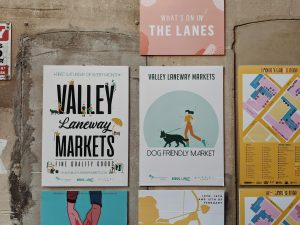
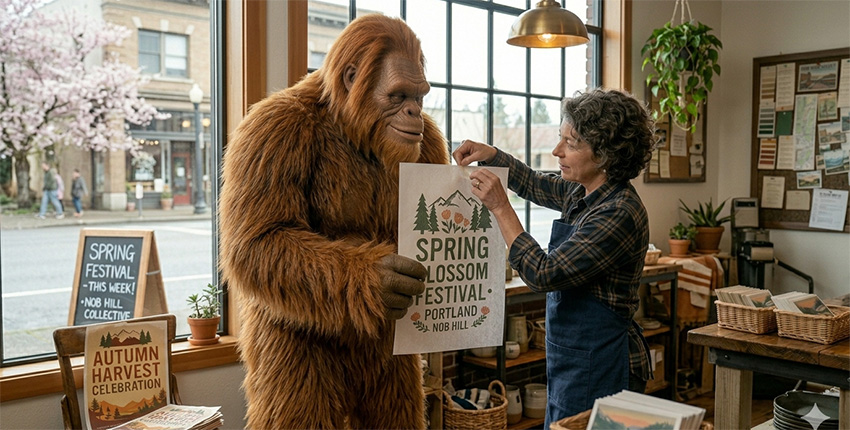
The coffee shop on Mississippi that has a new seasonal drink card every six weeks, printed small, changed when the menu changes. The boutique on Nob Hill with a window poster for the Buckman holiday market that went up the week before the market and came down the week after. The restaurant in the Hawthorne district that sends a postcard to the neighborhood when the spring menu launches; a few hundred, addressed locally, no national distribution.
None of these required a large budget. They required thinking about print the same way you think about everything else in a living business: as something that should be current, responsive, and honest about who you are right now.
That’s what small batch makes possible. And it’s the thing that most online vendors, with their minimum quantities and their dropdown menus, are structurally unable to offer you.
A Note on What Pressquatch Is Actually Offering Here
I want to be straightforward about something. Most print vendors make more money when you order more. We’re not immune to that math. But we’ve been on this floor long enough to know what happens to businesses that order in bulk from the wrong vendors, at the wrong quantities, for the wrong reasons, and we’d rather have a long relationship with a business that orders right than a large transaction from one that orders once.
Small batch is not a consolation prize. It’s what we built our model around. And we think it’s the right call for most of the local businesses we serve.
Tell Us What It’s For, Not Just How Many
Most print vendors will ask you for a quantity. We’d rather you start with a different question.
What’s this piece for? When does it need to be in someone’s hand? What’s it supposed to make them feel or do? How will you distribute it, and to how many people, in what context?
The answers to those questions will tell us, and you, what the right quantity actually is. And it’s usually not the number you’d guess at the beginning. Sometimes it’s less. Sometimes it’s a different format entirely. Sometimes it’s two smaller runs instead of one large one, timed to the moments that matter.
That conversation is free. It’s also the thing that keeps the box in your stockroom from growing.
Let’s figure out the right quantity together. Tell us what the piece is for and when you need it — not just how many. We’ll take it from there.
pressquatch.com · Portland, OR
And next time you’re looking at that box in the back room, the one with the materials that no longer quite fit, I want you to know it doesn’t have to keep refilling itself. There’s a better way to approach this. We’d be glad to show you.
— Percival