


It’s 10pm somewhere in Southeast Portland.
Maybe it’s a studio off Hawthorne. Maybe it’s a kitchen table in Buckman with three browser tabs open and a cold cup of coffee going ignored in the corner. Either way, there’s a designer staring at a comp she’s not quite sure about, not because the work is bad, but because she’s not entirely certain it’s right. And the client presentation is at 9am.
She’ll send it. She has to. And maybe it’ll land perfectly. Maybe the client will look at it and say exactly what she was hoping to hear.
Or maybe, and this is the version I’ve watched play out more times than I can count from behind this press, the client will squint at it and say the four words that start a revision spiral: “This isn’t quite it.”
No brief was written. Nothing was documented. The job was small, the timeline was tight, and stopping to ask seventeen clarifying questions felt like overkill for a two-color poster run. I understand. I’ve been on this floor for a long time, and I’ve watched the best creatives in this city make that exact call. Sometimes it works out fine.
Sometimes it absolutely doesn’t.
The brief isn’t bureaucracy. It’s the map you wish you’d had when the trail disappeared.
Here’s What I’ve Learned From the Press
The best print jobs we’ve ever run at Pressquatch didn’t start at the press. They started with a conversation, sometimes five minutes in the parking lot before a job dropped, sometimes a twenty-minute back-and-forth over email, where everyone got clear on one thing:
What does this piece actually need to do?
Not what does it need to look like. What does it need to do. What moment does it live in? What does the person holding it need to feel? Those are different questions, and the answers change everything, the stock weight, the finish, the size, the color. Everything.
That clarity is what a creative brief really is. Not a form you fill out before the fun starts. Not a deliverable you owe a client. A conversation you have before the chaos does. The jobs that skip it aren’t always disasters. But the ones that go sideways? In my experience, almost all of them skipped it.
Four Things That Actually Matter
I’m not going to hand you a twelve-field intake form and call it a framework. What I’m going to tell you is what we’ve learned from decades of running jobs for Portland creatives, the four things that, when a designer walks in without them, almost always cause a problem. Work these into every project, even the small ones. Especially the small ones.
- What is the piece for, really? Not the format. The moment. A loyalty card that lives in someone’s wallet needs to earn its place every single time it’s seen; it’s competing with their debit card, their coffee punch card, and three receipts they forgot to throw away. A poster in a Hawthorne shop window has roughly two seconds before someone decides whether to stop or keep walking. A postcard on a café counter is read in the time it takes to wait for a latte. If you don’t know the moment, you’re designing in a vacuum. Start here, every time.
- Where does it actually live? Hands, walls, windows, tote bags, coffee shop counters, bulletin boards, the inside of a paper bag. The answer changes everything about stock weight, bleed, finish, and dimensions. A piece that’s meant to be pinned to a corkboard needs different specs than one that’s getting folded into an envelope. A brief that doesn’t answer this question is a guess, and guesses cost reprints.
- What does the client think they want versus what will actually work? This is the one every freelancer knows but not everyone says out loud. Sometimes a client has a vision that is genuinely right. Sometimes they have a reference image from a brand with a $200K print budget and they don’t know that yet. It’s your job, and it’s a service, not a confrontation, to close that gap before the job goes to press, not after. A brief gives you the space to ask this question professionally, before anyone’s emotionally invested in a direction that won’t land.
- What’s the real deadline? There’s the date the client says. And there’s the date that actually matters, the event, the launch, the window when this thing has to be in someone’s hand to be useful. Those two dates are not always the same. A brief gets both on paper, which means you can plan a realistic production timeline instead of discovering the difference at 6pm the day before.
The four things: the moment, the location, the gap between vision and reality, and the real deadline. Get these on paper before anything else.
This City’s Creative Community Deserves Better Than a Reprint
I want to say something that isn’t a marketing line, because I mean it as a neighbor.
The creative community in this city, the brand consultants working out of shared studios in Buckman, the event designers pulling together materials for Alberta Arts District markets, the illustrators who need fifty copies of something beautiful and aren’t interested in five thousand copies of something adequate, these are our people. Pressquatch didn’t grow out of some corporate print franchise. We grew out of this city, out of decades in this industry, out of a genuine belief that small businesses and the creatives who serve them deserve the same quality and care that the big accounts get.
Keep Portland weird isn’t just a bumper sticker. It’s the operating principle of every small creative shop that chooses craft over scale, relationship over transaction, quality over the race to the bottom. That’s what we believe. It’s why we’re still here.
And it’s why a good brief matters to us as much as it matters to you. When you walk in with clarity about what you need, we can do our best work. When a job goes to press without it, we’re all guessing together, and guessing is nobody’s best work.
Come Talk to Us Before the Press
If you’re a Portland creative who’s ever had a print job come back wrong, wrong finish, wrong weight, wrong feeling, I’m not going to tell you it was because you didn’t write a brief. Sometimes it’s just a bad day on the floor. It happens.
But if you’ve ever gotten a comp approved, sent it to print, and watched the relationship with a client quietly cool because the thing in their hand wasn’t the thing in their head, that’s the brief. That’s the conversation that didn’t happen.
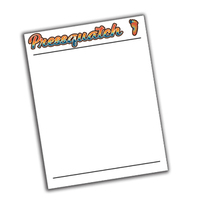
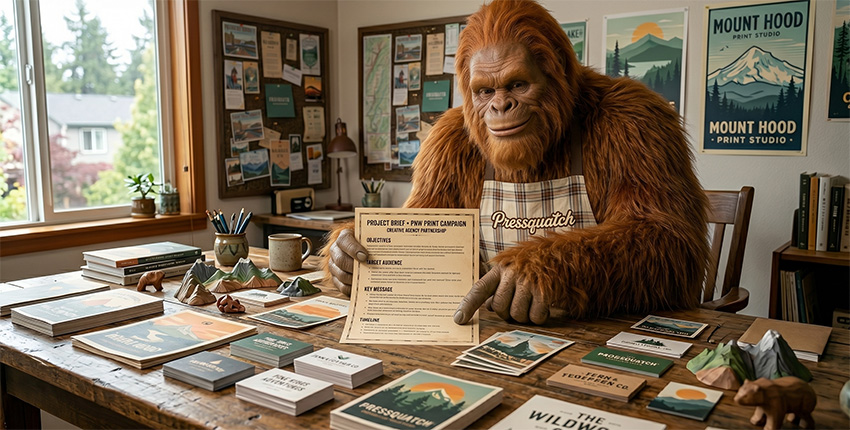
We made a simple one-page print brief you can use with every client, for every job. It’s the version we hand to people when they come in and aren’t sure where to start. It covers the four things above, plus the technical specs that keep jobs from hitting snags at the file stage. It’s free. Take it.
Download the Pressquatch Print Brief Template
One page. Four questions. Every job, every time. → pressquatch.com/print-brief
And if you’ve got a job coming up and you want to talk through it before anything goes to press, from Nob Hill to Hawthorne, we’re right here. We’ve probably seen it before.
— Percival